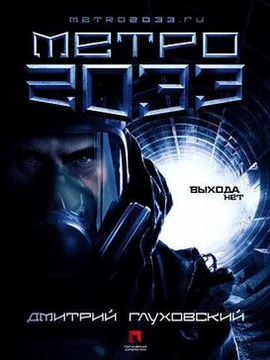
The Anarchists
No station, no leader, no law — only the tunnel and the next shot.

The Anarchists are a faction of survivors in the Metro 2033 universe who reject all forms of centralized authority, organized government, and hierarchical power. Rather than settling into one of the surviving stations and submitting to its council or military command, they have broken away into the open tunnels, living in small, loosely connected cells that answer to no one. Their philosophy is absolute: no leader, no law, no station, no chain of command. In both Dmitry Glukhovsky's original novel and 4A Games' video game adaptation, the Anarchists serve as a reminder that the post-apocalyptic world of the Moscow Metro is not simply a choice between the Red Army, the Military, or the Bandits. They represent a third, more radical impulse among the survivors: the belief that any structure of power, however desperate the circumstances, is itself a form of the old world's corruption. They are hostile to Artyom on sight, and there is no dialogue or negotiation that changes that.
- Type
- Faction / Loose collective of tunnel-dwellers
- Affiliation
- None — they reject all authority and station governance
- First appears
- Metro 2033 (novel by Dmitry Glukhovsky, 2005; game by 4A Games)
- Location
- Moscow Metro tunnels (outside any single station)
- Disposition toward Artyom
- Hostile; no negotiation option
- Leadership structure
- No single named leader in canon; operates in small autonomous cells
Lore & Background
In the world of Metro 2033, the stations are not merely shelters; they are the last functioning governments. Each one has a council, a military, a currency, a set of rules. The Anarchists look at that structure and see the old world's rot preserved in a smaller, darker form. To them, a station council deciding who eats and who starves is no different from the governments that let the world burn. They chose the tunnels, the cold, the dark, and the constant threat of the Dark Ones, over submission to any human authority. It is a choice that costs them comfort, safety, and numbers, but they consider it the only honest way to survive. They are not a single army. There is no Anarchist general, no flag, no unified doctrine beyond the core rejection of hierarchy. Cells of two, three, perhaps a handful of individuals operate independently, sharing a philosophy but not a command structure. This makes them unpredictable and difficult to eliminate, but also means they cannot mount a coordinated assault on any station. They are a pressure, a reminder, a philosophical provocation more than a military threat. In the tunnels they set their own rules, trade with no one, and kill without asking permission from a council. Their presence in the Metro is a narrative counterweight. Where the Red Army believes in revolution and the Military believes in order, the Anarchists believe in the absence of both. They force the player and the reader to confront the question of whether the stations' survival depends on the very structures the Anarchists despise, and whether a world without any authority is truly freedom or simply a slower, lonelier death.
In Their Own Story
The tunnel beyond the last lit doorway smells of rust and wet stone. Artyom's flashlight cuts a pale cone through the dark and finds them first: a figure crouched on a broken rail, face wrapped in scavenged cloth, a rifle held across the knees with the calm of someone who has been waiting a long time. Behind the figure, deeper in the black, two more shapes shift. No insignia. No station patch. No uniform. Just the dark and the metal and the quiet click of a bolt being eased home. The one in front does not shout. Does not demand to know who he is or which station he came from. He simply looks at Artyom the way you look at a thing that has no right to be there — a structure, a rule, a line drawn by someone else. Then he raises the rifle, and the tunnel fills with the flat crack of a shot and the smell of cordite, and the dark closes back in like it was never opened at all.
Reader's Guide
The Anarchists are a faction rather than a single named character, so their profile is best understood as a collective. Name: The Anarchists (no single canonical title or leader is given in the novel or the game). Role: Hostile tunnel-dwellers encountered in the open sections of the Moscow Metro. Affiliation: None. They explicitly reject station councils, the Red Army, the Military, and any other organized authority. They operate in small, autonomous cells of a few individuals, with no chain of command and no shared base beyond the tunnels themselves. First appearance: They are referenced in Dmitry Glukhovsky's 2005 novel Metro 2033 and appear as a combat encounter in 4A Games' Metro 2033 (2010) and its sequel Metro: Last Light (2014). In the game, the player meets them in the unlit tunnel sections between stations, where they are hostile on contact and offer no dialogue or trade options. Narrative summary: The Anarchists do not have a long, plotted arc the way the Red Army or the Military do. They are a fixed point in the Metro's ecology: a faction that exists to embody the idea that the post-war world is not only a question of who rules, but whether anyone should rule at all. They are encountered, fought, and left behind. They do not join Artyom, do not betray him, do not appear in the finale. Their significance is philosophical and atmospheric. They are the reason the tunnels feel truly dangerous — not because of the Dark Ones or the Bandits, but because there are other human beings out in the dark who will not talk, will not trade, and will not explain why they are shooting. They are the Metro's reminder that freedom, taken to its logical extreme, is indistinguishable from the void. Key relationships: Hostile to every other faction. No named individual relationships exist in the canon. They are defined by their absence of ties.
Did You Know?
- The Anarchists have no single named leader, no station base, and no flag in either the novel or the game — they are defined entirely by what they refuse to be.
- In the game, encountering the Anarchists in the tunnels offers no dialogue or negotiation option; the interaction is purely combat, reinforcing their rejection of all social structures.
- Their philosophy serves as a narrative counterpoint to both the Red Army's revolutionary order and the Military's institutional order, presenting a third path: the absence of order itself.
- They are one of several distinct factions the player meets in the Metro, alongside the Bandits, the Red Army, and the Military, each representing a different answer to the question of how to survive underground.
Elsewhere in the Metro 2033 universe
Spotted an error? Know more?
This is a living reference — every entry is fact-audited, and reader corrections feed straight into our audit queue. Suggest an edit · See this site's audit record